








KAMRA Inlay
KAMRA Inlay |
||
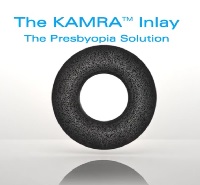 The KAMRA Inlay Small Aperture Solution for Presbyopia
The Presbyopia Solution You've Been Waiting For
By 2020, there will be an estimated 2.1 billion presbyopes worldwide. While multiple options exist to treat this patient segment, some are temporary and most require significant compromise. For surgeons seeking a long-lasting solution for these patients, there is KAMRA Inlay.
KAMRA Inlay Delivers:
Full Range of Vision: Delivers a complete uninterrrupted range of vision
Excellent Outcomes: Achieves an avarage of J2 uncorrected binocular visual acuity at near and 20/16 uncorrected binocular visual acuity at far in clinical study patients
High Safety Profile: Provides an option to remove the inlay, which keeps patient's future options open.
The KAMRA Inlay Difference
1.Extended Depth of Focus
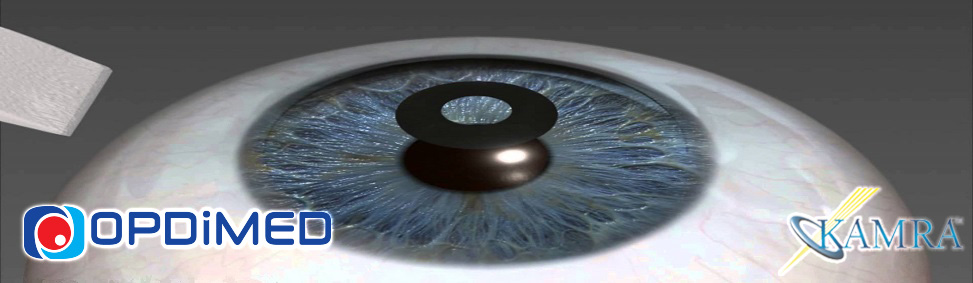
The design of the KAMRA Inlay delivers an extended depth of focus while;
- Maintaining contrast sensitivity in all lighting conditions. - Allowing the patient to see from near to far without blur zones. - Providing the ability to achieve up to 2.25 diopters (D) of add (achieved when patient has a refraction between -0.50 and -0.75 D) - By applying the depth of focus principle commonly used in photography, the KAMRA inlay controls light transmission allowing only central rays to reach the retina through the fixed 1.6 mm aperture.
2.Maintain Stereopsis
With the KAMRA Inlay, there is no change to the refraction of either eye, allowing both eyes to be refracted to their optimal acuity This is why a KAMRA patient can enjoy excellent vision from near to far. Unlike the KAMRA Inlay, monovision does change the refraction of at least one eye, which typically results in the loss of binocularity and stereopsis.
3. Long-Term Performance
Outcomes from a long-term study demonstrate KAMRA patients achieve mean uncorrected visual acuity of 20/25 in their inlay implanted eye across all distances. This change represents an avarage gain of 3.2 lines of near acuity. After five years of follow-up, vision remained stable, with no need to exchange for a higher power. The US pivotal clinical study data reported an average gain of about 3 lines of near visual acuity.
|
||
